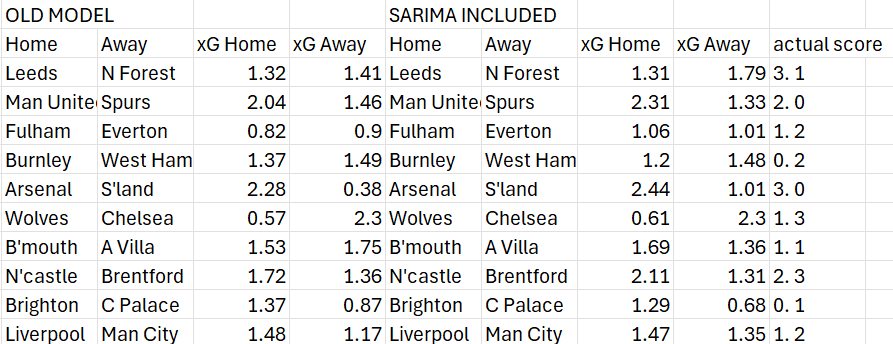
Accuracy with added SARIMA model: 6/20 teams predicted- 30%
Accuracy without added SARIMA model: 9/20 – 45%
Thoughts
Incorporating the time-series SARIMA model, actually reduced my prediction accuracy by 15%. This could be because time series methods assume that past patterns and trends in performance will persist into the future, but football is noisy, and influenced by external factors such as injuries, rotation, and fixture congestion.
Goals and xG are low count and high variance metrics, making them different to forecast reliably. Classical time series techniques perform better on more smother and stable data. I still want to continue this technique again, but for next week, I will reduce the weighting this has in my model from 30% to 20%.
What went right?
Wolves vs Chelsea (1-3)
This match played out quite similar to expected. Wolves have increased their attacking threat in the new year, scoring 6 against Shrewsbury in the FA cup.
xG data from BBCSport suggested that the xG data was a fair result of the game. My models prediction of 0.61 to 2.3 wasn’t too far off.

What went wrong?
Leeds vs Forest (3-1)
Watching the game, it looked like Leeds had a well-deserved win, playing brilliantly. I thought that, due to an uptick in Forest’s form (unbeaten since 3rd January) the game would’ve been a lot closer. Although, ‘Footystats.org’ gave leeds an xG of 1.58 compared to Forest’s 1.17, suggesting I had an accurate prediction beforehand.
Opta predicts a 4.75% chance of Leeds going down, with Forest on 10.24%.
Next week
I’ll make steps to reduce the impact of my new time series model. I’ll post predictions with and without SARIMA for comparison.
I’ll also try another technique, such as the Monte Carlo simulation, at one game (Tottenham vs Newcastle) I will look online at betting exchanges, and see if I can find any value in under/over goal bets. Due to matches being played throughout the week, this will be posted tomorrow.
 Predicting Premier League games
Leave a comment