Backing the favourite is a common (and easiest) strategy in horse racing. Instead of guessing, I wanted to examine the numbers to see whether this was effective. In this post, I’m using race data, Starting Price (SP) odds, and a few Excel pivot tables to answer a basic question:
Do favourites win often enough to justify their price?
Rather than predicting a single race, this is about looking at patterns across many races and seeing what the maths says.
To test whether favourites are actually worth backing, I simulated the simplest strategy imaginable: Bet £1 on every favourite at SP. No pretending I know something the market doesn’t. Just pure, blind loyalty to the top of the betting board.

Method
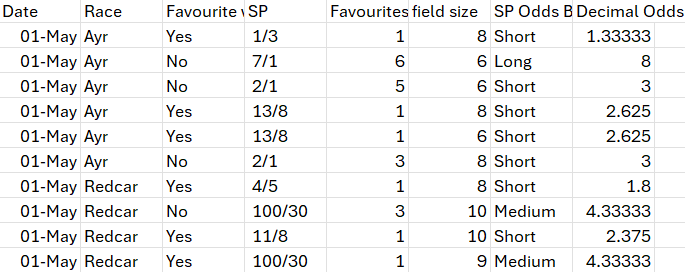
I used https://www.racingpost.com/ manually trawl through 100 race results from May 2025, which was recorded on Excel. I then created PivotTables to try find any patterns in the data.
Favourite Win Rate
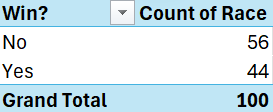
Starting off, the data shows that the favourite wins 44% of the time. When I broke the data down by field size, A clear pattern emerged. Less horses= more likely for favourite to win. This makes intuitive sense as in smaller fields there is less traffic, randomness and chaos.
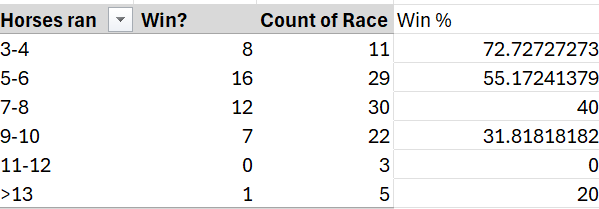
If you’re blindly backing favourites, you’re not betting on a fixed 44% strike rate. You’re betting on something that changes depending on race conditions. A favourite in a 5-runner race behaves very differently from a favourite in a 14-runner handicap.
Performance score
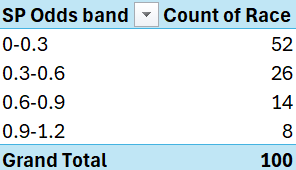
Win rate only tells part of the story, as A favourite that finishes second in a 12-runner race has still run well even if it didn’t win. To capture this, I assigned each favourite a relative performance score based on its finishing position and the size of the field. (Formula used: Finishing position ÷ Field Size, so 1st out of 10 were given 0.1, and 10th out of 10 were given a score of 1).
52 Favourites scored between 0-0.3, suggesting that many are still running competitively, even if they aren’t finishing 1st.
However, the interesting question isn’t whether favourites perform well, It’s whether they perform well enough relative to their price. And that’s where profitability and SP bands come into play.
Net expected earnings if you always bet the favourite
To test whether favourites are actually worth backing, a simple strategy was simulated. I bet £1 on every favourite at Starting Price (SP). To calculate profit, I converted the fractional odds into decimal odds and applied a simple formula: If it lost → −£1, if the favourite won → Profit = Decimal Odds − 1.
After 100 races, the result was:
- Total profit: -£1.49
- Average loss per bet: ~1.5p
So blindly backing every favourite would have left you just under £1.50 down across 100 bets. This reinforces the idea that the favourites are priced very efficiently.
Profit by Race Venue
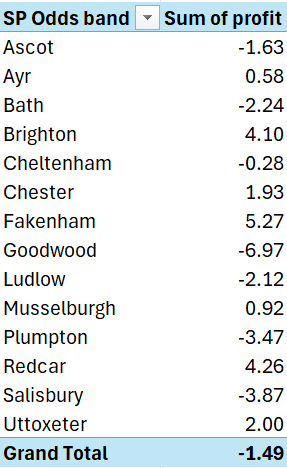
Some tracks performed much better than others. Fakenham was the most profitable venue in the sample, whereas Goodwood was the least profitable, suggesting that structural differences, such as track layout, weather, and field size, may influence how accurately favourites are priced.
Odds Band Analysis
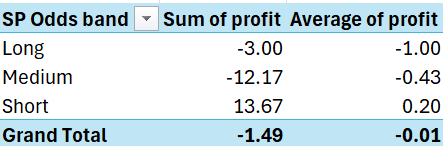
When I broke the results down by SP Odds Band, things got more interesting. If you had backed only short-priced favourites (decimal odds under 3), you would have turned a £13.67 profit!
Despite offering lower returns per win, short favourites win more consistently, limit variance and outperform the broader favourite pool.
Limitations and Next steps
Before getting too excited: My dataset showed a 44% favourite win rate, whereas a quick Google suggests this is higher than expected, as historically favourites win closer to 35% of the time. So either I ran hot, May 2025 was chaotic, or my sample is just small (spoiler: it’s this one). The 100-race sample has a large variance, is only from one month, and includes many different types of races.
The next step would be:
- Expand sample size (1,000+ races)
- Segment by race type
- Control for field size
- Compare BSP vs SP
- Measure ROI volatility
Final Thought
The betting market isn’t stupid. It’s very hard to beat by doing something obvious. But sometimes, when the market is very sure, it might still be slightly cautious. And that tiny difference? That’s where edge usually hides.
Thank you for reading.

 Predicting Premier League games
Leave a comment